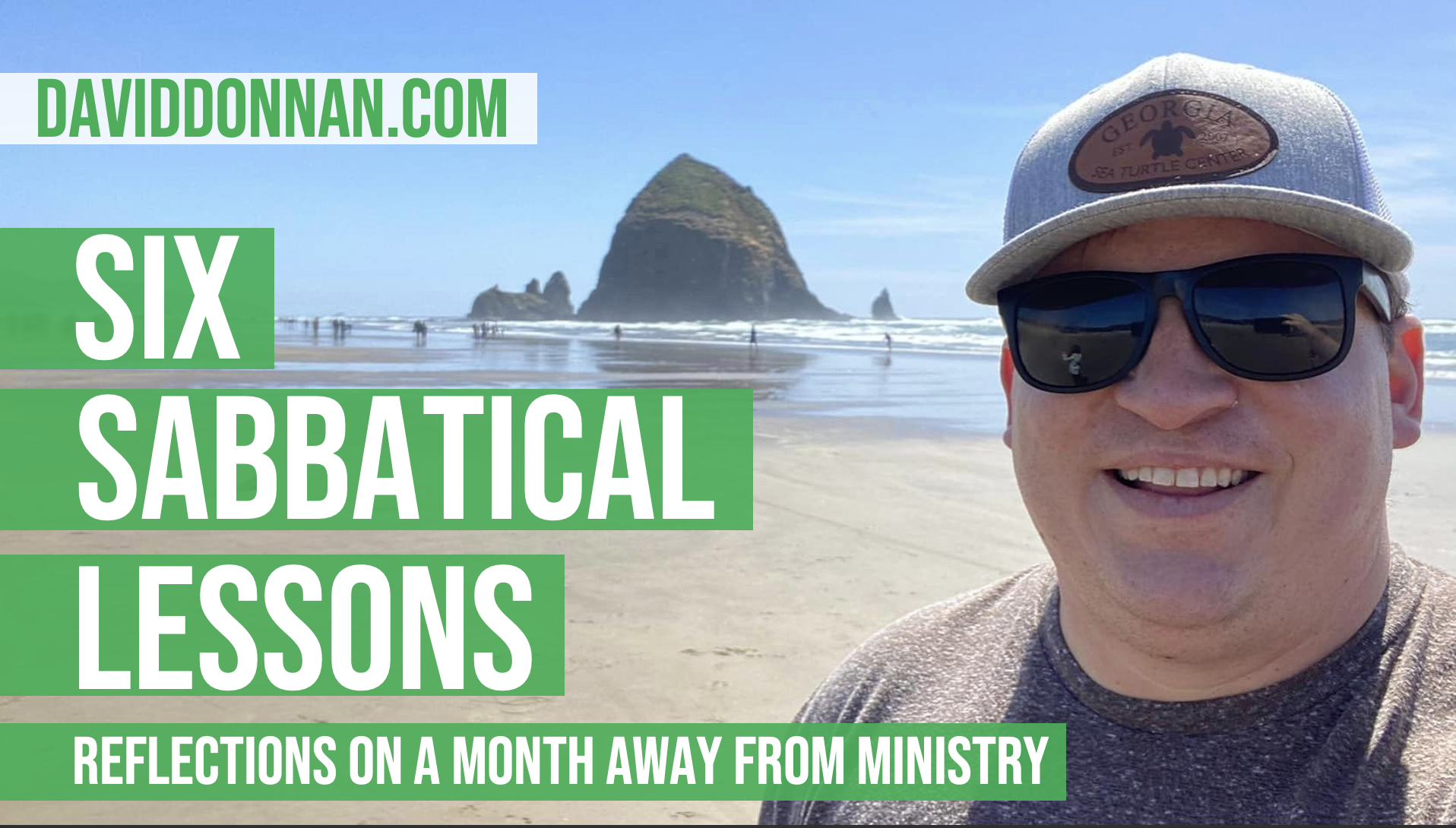
I have been very blessed to have four consecutive weeks off in a form of spiritual sabbatical renewal leave from my local church. This time has been a gift for my family and I. It has been a fruitful time of rest where I moved outside the normal demands of pastoral leadership in order to make space for God to bring renewal. During my time away I worshiped each Sunday in a different congregation. My family and I traveled extensively spending time with family and enjoying God’s creation.
Here are the top six lessons I learned on sabbatical.
#6 A Deeper Appreciation for the Long View of Preaching.
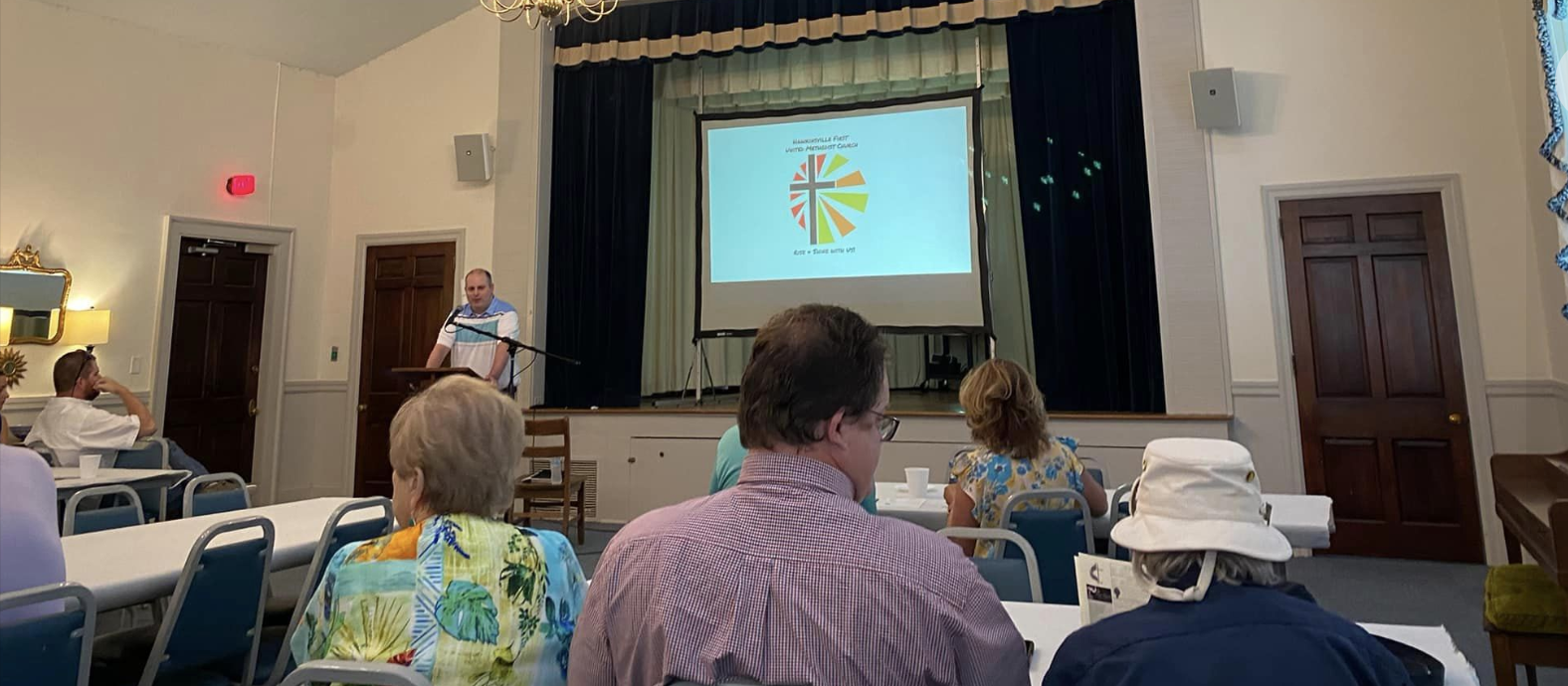
When I played high school football I was obsessed with the team we were playing that Friday night. I would think about them, study film, and even write the opponent’s school name at the top of my class notes so I could focus on them. Preaching can be of a similar intensity. The “term paper” is always coming each week. Even more than the pressure of a good grade is the responsibility to preach God’s word faithfully.
Sitting with the congregation for weeks in a row was a reminder that Christian worship is deeper than the sermon (although please do not interpret this as a diminishing view of the sermon). Sermons absolutely have a role to play. Yet, there is so much more going on during worship. There is community, there is worship through song, there is confession and pardon, there is rhythm of gathering and sending out.
My hope as I return to the pulpit is fresh, relevant, faithful preaching. I also hope to have a renewed confidence in how God is working in so much more than just the preaching.
#5 A Clearer Vision for My Calling
This season of pondering the future of Methodism and Christianity has given me plenty of time to consider my calling. There has been a renewed understanding of how I am called to cheer on people for what God is doing in their life. I also have a clearer understanding of my role as someone, like all Christians, called to share the Good News of Jesus Christ. Specifically, how the Triune God who created the world and everyone in it loves the world and everyone in it. This God cares deeply for everyone and provided a path to eternal life, here and now, through Jesus Christ’s sacrifice for our sin. It is a free gift. No matter how good, smart, pretty, successful, or friendly you are, you can not earn it. It is the greatest gift you can ever receive.
#4 An Extending Gratitude to the Local Church
While I have gotten clarity on my calling I have also grown in my gratitude for my local church. To all of our knowledge no one has ever been given a sabbatical leave like this before. It was new for me and for them. The Christ-followers at Glennville Methodist Church were very encouraging.
A few years ago I had a very traumatic church meeting where some trusted friends blindsided me and unloaded some frustrations on me again and again. That night I went home literally shaking. Even though it was over ten years ago, I still think it is going to happen again.
Nothing could be further from the truth in almost all other ministry contexts I have served in. Particularly here I have received a bounty of prayer and encouragement. I wish everyone had a chance to serve and live in Glennville.
I also realize having a sabbatical is a privilege most churches and professions in America do not enjoy. I am extremely grateful to have had this unique benefit.
#3 Being with God vs Doing for God

This is not a new theme for me. I discovered it a couple of years ago from Rev. Pete Scazzero. The time away showed me how I can turn almost everything into an act to please God or even worse a chore to be done.
I am not really sure I have come to a clear answer on how to combat this. There are a couple of ways I hope to experiment with this through some questioning.
The first question to ask myself is this: Am I trying to do too much for God?
Do not get me wrong, the Lord calls us to do great things that stretch us personally. However, for me, this question points to my inability to be happy for what Christ has for me today. This question is a reminder that if I have so much on my to-do list that there needs to be two or three of me to get my tasks done then I am probably trying to move at too fast of pace. I am probably not trusting God’s timing but trying to usurp God’s will by achieving in a way that is subtly trying to earn my own salvation.
The second question to ask is: Am I enjoying God?
This one is more straightforward. Am I enjoying God and God’s blessings in my life or am I obsessed with my own pleasure or comfort. Surely there will be days that are not enjoyable. Yet, even in those days we can enjoy God’s presence and comfort.
#2 There are Piles of Beauty and Heaps of Sadness in this World

One of the blessings of my time away was the privilege of travel we experienced. We hiked in the Smoky Mountains in Tennessee. We saw the beauty of waterfalls in the Pacific Northwest. We played in Beautiful public parks in the State of Washington. We felt the thrill of rushing to make a connecting flight in the Houston George Bush International Airport while the air conditioning was out in the airport on a hot June day. We experienced extreme generosity from my family who hosted us in Portland. For the first time, we saw the West Coast and put our feet in the cold Pacific water at Haystack Rock on Cannon Beach.
Along with beauty we also saw despair. While on a day date in Savannah, Brandy and I saw what appeared to be a homeless man going through the trash looking for watered down alcohol beverages that had been discarded. While on a date in downtown Portland, we walked beside a group of gentlemen sharing needles and heating something in tin foil (I do not think the answer is to stop going on dates with my wife). We showed our children the tent cities in Portland and pondered how they handle the colder winters than what we are used to in Georgia. We talked about how each of these people have someone who loves them and is worried about them.
I’ll confess I do not have an easy application to this lesson. This is more of acknowledgement of the sadness in our world displayed in poverty and addiction and call to prayer and action where possible.
#1 Do No Harm… to Myself.
John Wesley, the founder of Methodism, had rules for those striving to follow Christ. They were (1) Do no Harm, (2) Do all the Good You Can, (3) Attend to the Ordinances of the Church.
David Watson has an excellent article about how Wesley saw these rules as external actions. Wesley pointed out how if we only have these outward actions we are pharisees. Wesley taught how we needed inward holiness as well.
My take is this, what if we asked, “How can we do no harm to ourselves for the sake of Christ?”
Ministry is notoriously well known for having a high rate of burn out. Rev. Tish Harrison Warren talked about a recent survey in a piece published in the New York Times. She talked about some of the challenges pastor face:
“The top reported reasons for clergy burnout were the same ones that people in the population at large face: stress, loneliness and political division. But these stressors affect pastors in a unique way. Pastors bear not only their own pain but also the weight of an entire community’s grief, divisions and anxieties. They are charged with the task of continuing to love and care for even those within their church who disagree with them vehemently and vocally. These past years required them to make decisions they were not prepared for that affected the health and spiritual formation of their community, and any decisions they made would likely mean that someone in their church would feel hurt or marginalized.”
Author James Clear in his book Atomic Habits talks about each day being a vote for the type of person we want to be. Clear talks about how we need to have more yes votes for the person we want to be rather than no votes.
If clergy are to have a long, faithful, and fruitful ministry I think it starts with examining if we are doing harm to ourselves. This can be in addiction, neglect of health, being too career focused or some other struggle. I personally need to examine whether I am doing harm to myself in my daily habits, rhythms, or neglect of my health. Am I willing to vote for the person I feel like God is calling me to be? Am I willing to do no harm to myself for the sake of others and love of Christ?
More From David
About the Global Methodist Church
David Donnan Podcast Season 2 Episode 1 How Prayer Changes Us with Rev. Dr. Ted Goshorn
March 15, 2023

In season two, I will be exploring the topic of prayer and sharing insights and practical tips for developing a strong prayer practice. I am calling this season Even Deeper in Prayer. Each episode will feature engaging conversations with experts in the field, as well as personal stories and reflections from me.
Click to Listen on Apple Podcast, Youtube, and Spotify.
It was a special conversation on prayer with the Rev. Dr. Ted Goshorn.
Here are some ways to connect with Ted.
- Ted’s Website: tedgoshorn.org/
- Ted’s Book on Amazon
- Ted on Twitter: https: Twitter.com/tgoshorn
- My review on Prayer Changes Us
Resources Mentioned in the Interview
- Word on Fire Daily Office
- Green Bough House of Prayer
- 876 Pendleton Creek Rd, Adrian, GA 31002
- Telephone: (478) 668-4758
- Book: The Road Back to You
Full Video of the Episode
For the past several months I have had the opportunity to share with individuals and groups about the Global Methodist Church. This is the talk I give formatted for my blog.
#1 To Stay Connected to our True Wesleyan/Methodist Heritage
“Since its inception, God’s Spirit has enlivened the Methodist movement. In the 1720s John and Charles Wesley and friends at Oxford University met together to deepen their Christian faith through daily, practical spiritual disciplines. Derided by others as a ‘new sect of Methodists’ for their ‘methodical’ ways of practicing the faith and holding one another accountable to it, the small group embraced the insult and persevered in their fellowship. And so they and the millions who followed after them have ever since been known as ‘the people called Methodists.’”1
The term Methodist still has deep meaning to me personally. I believe Wesleyan theology is a gift to the entire Body of Christ with its emphasis on God’s Grace, freed will, and His call on His people to make a difference in this world.
#2 To Provide Structure for Our Local Church to Better Serve the Community
The Global Methodist Church (GMC) will have a light touch on how you structure your church. Our Transitional Book of Doctrine and Discipline says “The basic organizational plan for the local church may be designed by each congregation in such a manner that it provides for a comprehensive program of nurture, outreach and witness to all.”2
If you like, you can still have the same structure you used in the prior denomination. However, we offer flexibility as long as you have a governing board. There is the familiar charge conference and nominations to help you approve your leadership, budget, and pastor compensation.
#3 To Have Our Preacher Held Accountable and Encouraged
The pastor is “responsible for ensuring that members are cared for by implementing a discipleship process focused on helping members to ‘go on to perfection’ by loving God with all of their heart, mind, soul, and strength, and by loving their neighbor as themselves. [You] are charged with equipping all the members of a congregation to be in ministry by meeting people at their point of need and offering them Jesus.”3
Pastor’s will have the support of their fellow clergy as well as a board of ordained ministry.
#4 You Keep Control of Your Church Property
“God owns all of creation (Psalm 50:9-10); we are but stewards of it for a period of time. Property (real, personal, tangible, and intangible) deeded or titled in the name of the Global Methodist Church and its entities (including its local churches) is to be used for the glory of God and to carry out the mission of making disciples of Jesus Christ and to spread scriptural holiness across the land
There is no trust clause for property held by local churches, annual conferences, regional conferences, connectional commissions, the Transitional Leadership Council, or any of their entities.”4
#5 High Standards and High Openness to Input
“A leader’s job—whether at the top of an organization or somewhere in the middle—is to create a safe space for people to speak up, make mistakes, and bring their full selves to work.” – Amy Edmondson, Harvard Business School
My hope, and for many in the GMC, is for us to have a grassroots led church. The days of believing God’s Spirit only blows from the top down are over.
Evidence of this is there is no required connectional giving for the first two years. Connectional giving will be capped at 6.5% (1.5% for wider church, 5.0% at the annual conference).
#6 The Future of the Church is Global
The past years in the United States have made many weary of globalism. We have seen how supply chain issues during the pandemic have pointed out the fragility of our global infrastructure. We have seen jobs shipped overseas and the detrimental effect it has had on industries like steel production as tens of thousands of workers are displaced.
Yet, our legitimate worries about globalism should not make us weary of the global nature and mission of the church.
In Genesis 22:18 (CEB) God tells Abraham, “All the nations of the earth will be blessed because of your descendants, because you obeyed me.”David F. Watson says, “There is great need for both theological education and academic theological discourse in places outside of the Global West, and we need to be involved…We would do well intentionally to collaborate with people from the majority world.”5
*****
1 The Transitional Book of Doctrine and Discipline preface page 3
2 The Transitional Book of Doctrine and Discipline paragraph 337 page 33
3 The Transitional Book of Doctrine and Discipline paragraph 322 p. 29 (Ephesians 4:11-13).
4 The Transitional Book of Doctrine and Discipline Selections from paragraphs 901 and 902 p. 100
5 https://daviddonnan.com/2022/06/10/the-global-nature-of-the-future-methodism/
*****
More From David
 David Donnan