Philippians 1:1-11 Work to be Done
October 4, 2026

These are my notes used for my sermon. If you watch what actually you was preached you notice some/a lot of variance. There still may be some devotional of information value.
There’s this famous saying of Jesus in the Gospel. It is from Matthew 11
28 “Come to me, all you who are weary and burdened, and I will give you rest. 29 Take my yoke upon you and learn from me, for I am gentle and humble in heart, and you will find rest for your souls. 30 For my yoke is easy and my burden is light.”
Here is the thing… this can be hard to believe. I have had several days where I would look at my to-do list, calendar, worry, or circumstances and think, “This does not look like it is going to be a light day, week, or season.”
Maybe you have been there?
So how can this be true? How can the Christian life really feel light? Well I think Paul answers that in our introduction to Philippians.
Today, we begin our journey through the Philippians. I want to encourage you to take the card in your bulletin and memorize this passage (Also, a note, the card is the New Living Translation not the NIV for our eagle eye viewers).
In this series we will spend more time on the background and characters here. For today, Philippians was written by the Apostle Paul, a leader and martyr of the church. Some say Paul is the most important person in regard to the spread of Christianity after Christ.
Paul is not writing to the Philippians from his podcast studio, a nice ivory tower study, or from a fancy mansion. Paul is writing from prison.
Hear these words from Philippians chapter 1, verse 1 through 11.
1 Paul and Timothy, servants of Christ Jesus,
To all God’s holy people in Christ Jesus at Philippi, together with the overseers and deacons:
2 Grace and peace to you from God our Father and the Lord Jesus Christ.
3 I thank my God every time I remember you. 4 In all my prayers for all of you, I always pray with joy 5 because of your partnership in the gospel from the first day until now, 6 being confident of this, that he who began a good work in you will carry it on to completion until the day of Christ Jesus.
7 It is right for me to feel this way about all of you, since I have you in my heart and, whether I am in chains or defending and confirming the gospel, all of you share in God’s grace with me. 8 God can testify how I long for all of you with the affection of Christ Jesus.
9 And this is my prayer: that your love may abound more and more in knowledge and depth of insight, 10 so that you may be able to discern what is best and may be pure and blameless for the day of Christ, 11 filled with the fruit of righteousness that comes through Jesus Christ—to the glory and praise of God.
May God add his blessing to the reading of his word.
How many of you feel a little overwhelmed sometimes? I think calling this letter to Philippians is good… but maybe better: Paul’s letter to the overwhelmed, the anxious, maybe even joyless.
Many scholars actually say this letter is about joy even in spite of the hardship faced by the local church.
Well we all have hardship today. Whether it is feeling overwhelmed, the stress of trying to get everything done, the struggles of health and aging.
What Paul has just said here though can help us. He tells us what we can do… nothing… well not exactly nothing.
Let’s look at verse 6 again: being confident of this, that he who began a good work in you will carry it on to completion until the day of Christ Jesus.
Notice who is going to do the work, who will carry it on to completion: Is it the preacher? Is it the seminary presidents? Is it political leaders? What about Sunday school teachers?
Paul is confident that “he” who began the good work… or as the NLT makes clear “God” will carry it on to completion.
This is what it means to be Holy, we are trusting in God’s work, his grace not our own strength.
This past week Brandy won the Donnan family reunion 5k… now we have some real speedsters in our family. But the 5k was not based on speed. It was based on guessing your finish time then running without a watch and whoever was closest was the winner.
You had to run in faith and see where you ended up.
In a similar way, we do this with our spiritual life. We set out to run our race but we also know there is a part we just do not know. A part we can just not quite know the timing of. Yet, we will see at the end where we ended up.
So how do we actually do this? We can’t throw away our phones and watches every day.
Well we do it together. I saw one of the coolest formations at the Pinewood middle school game on Thursday. Towards the end of the game Phillip (names of youth changed for privacy) was in at running back and Willie was the QB. For a moment it was just the Glennville Methodist backfield. The GMC package. Two Methodists together moving forward.
Church, there is work to be done… but we do not do it alone. We do it beside each other. And most importantly we do it trusting in God.
The work that he began in you… he knows about it. God has not forgotten about it. Christ just didn’t die on the cross and forget about you. The Holy Spirit just didn’t forget about comforting you in your loss.
No, the one who began this good work is still working. Let us trust in God to do this and keep our eyes open to how He is doing this.
In the Name of the Father, Son, and Holy Spirit Amen.
Exodus is More Than Escape: An Endorsement of Exodus and the Mission of God’s Holy People by Brian Russell
September 29, 2026
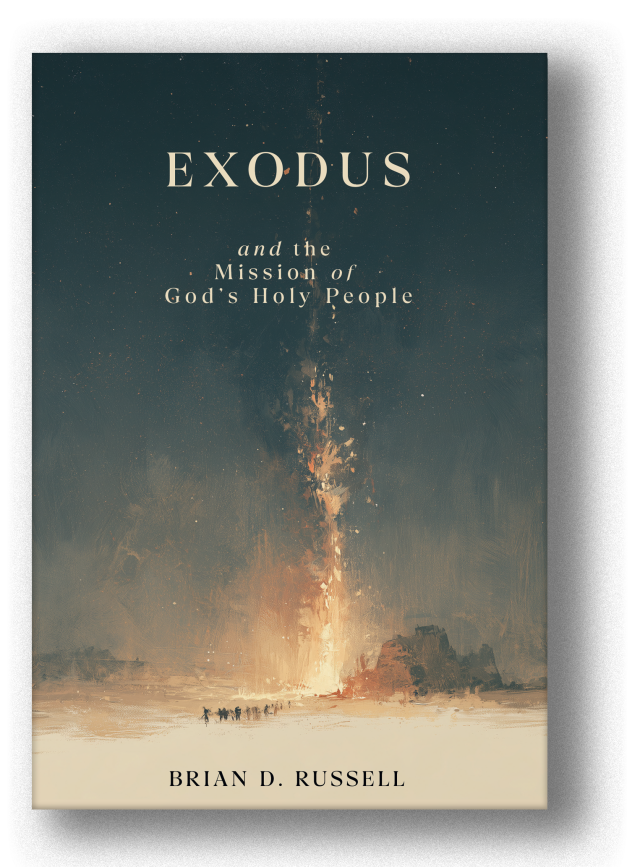
I had the privilege of reading an advanced reader’s copy of Exodus and the Mission of God’s Holy People by my mentor, friend, and seminary professor Dr. Brian Russell. I highly recommend this amazing work from Dr. Russell, published by Invite Press.
Dr. Russell is one of the top Wesleyan scholars in biblical studies. If you are not able to take a class with him, this is the next best opportunity. It is classic Dr. Russell in which he clearly explains the text and takes us even deeper.
Exodus and the Mission of God’s Holy People points out how most of us, including me, view Exodus: as the story of leaving Egypt.
Dr. Russell points out, “…Israel is free from Egypt by Exodus 15:21. The giving of the Ten Commandments occurs in Exodus 20. Yet there are forty chapters in the book… The true climax of the book of Exodus is the Lord’s glory filling the Tabernacle and God’s presence in the cloud and fire leading the redeemed and holy people of God into the world as witnesses.”
He goes on to say, “…it was easier for God to get Israel out of Egypt than it was for God to get Egypt out of Israel.”
Dr. Russell goes on to discuss key interpretive issues in Exodus such as why God elevates Israel, whether Pharoah has free will, and how we wrestle with slavery in the scriptures. Most importantly, we see how the call to be holy for Israel is also the call for all Christ-followers today.
Preachers, as you plan your small groups and programming for next year, I highly recommend considering this as a resource.
Small-group and bible study leaders would find this very helpful. Invite Press and Dr. Russell has a workbook scheduled for a release in early November, and I am making my pre-order today.
Lovers of the Scriptures will find this an accessible book which can be formative for devotional reading.
One final note: Dr. Russell is rumored to be willing to join a study via Zoom or make a clip and send your group a video. I highly recommend you reach out to him for this, his coaching services, or just to follow his blog, podcast, and future publishing.
Brian Russell Information
- The New Book: Exodus and the Mission of God’s Holy People
- Brian’s Website
- Brian’s Books
- Brian’s Podcast
Disclosure: As an Amazon Associate, I earn from qualifying purchases. This means I may receive a small commission if you click on an affiliate link and make a purchase, at no additional cost to you. Thank you for supporting my work!
About David Wesley Donnan
I write online about Methodism, devotional insights, and personal reflections. My primary goal is to organize my thoughts and explore meaningful topics. Along the way, I hope my writing inspires and encourages others on their journey.
More From David
Follow Me on Social Media
General Conference Briefing: Proposed Articles of Faith
June 11, 2026

Disclaimer: This briefing was prepared for the South Georgia GMC delegation using NotebookLM to synthesize information from multiple sources. It is intended to summarize the proposed Articles of Faith legislation and the major conversations surrounding it. It does not represent an official position of the South Georgia Conference or its delegation. Readers are encouraged to consult the original sources listed below.
One of the most significant pieces of legislation coming before the 2026 General Conference is Petition 1441, the proposed Articles of Faith.
The legislation would replace the Global Methodist Church’s two inherited doctrinal standards—the Methodist Articles of Religion and the Evangelical United Brethren (EUB) Confession of Faith—with a single unified statement of faith. The proposal was developed by a writing team working under the Commission on Discipleship, Doctrine, and Just Ministry in response to action taken by the Convening General Conference in 2024.
Why Was This Proposal Created?
When the Global Methodist Church was formed, it inherited two doctrinal standards from its Methodist roots. While both documents have served the church well, General Conference directed the Commission to develop a single statement that could serve as a unified doctrinal standard for the denomination moving forward.
Supporters of the proposal argue that a single document provides greater clarity, accessibility, and consistency for a growing global church. Critics generally agree with the goal of a unified statement but have raised questions about whether the Commission produced a simple combination of the two existing documents or created a broader theological synthesis.
Major Conversations Surrounding the Proposal
1. The Doctrine of Scripture
The most discussed portion of the proposal is Article VIII on Holy Scripture. The article describes Scripture as “without error in all it affirms.”
Supporters argue that this language reflects historic Christian teaching, aligns with statements such as the Lausanne Covenant, and is consistent with many classical Methodist theologians.
Critics argue that the language imports categories more commonly associated with modern evangelical or Reformed debates. They contend that Wesleyan theology has traditionally emphasized Scripture’s role in forming holy people and revealing God’s saving truth rather than focusing on philosophical questions about errorlessness.
2. Human Nature and the Image of God
Earlier drafts described humanity as “fundamentally good.” Some readers expressed concern that the phrase could weaken the doctrine of humanity’s fallen condition or imply a Pelagian understanding of human nature.
The writing team responded that the phrase was intended to affirm the continuing reality of the image of God in every person, not deny humanity’s fallenness. In response to feedback, the final language was revised to describe humanity as “created good” or “originally good.”
3. Combination or New Synthesis?
Another significant discussion centers on the Commission’s mandate.
Some have argued that General Conference requested a combination of the Articles of Religion and the EUB Confession of Faith and that the proposal goes beyond that instruction by introducing substantial new language.
The Commission has responded that a simple merger of two nineteenth- and twentieth-century documents would not adequately serve the church’s present mission. They argue that the proposal remains faithful to the historic doctrines of Methodism while presenting them in a clearer and more unified form.
4. Ecumenical Language
The proposal also removes several anti-Roman Catholic statements found in older doctrinal documents.
Supporters view this as an expression of ecumenical maturity that allows the church to affirm historic Christian doctrine without retaining polemical language from earlier centuries.
Others worry that removing such language may blur important theological distinctions that earlier Methodists believed were necessary to maintain.
How We Arrived Here
- 2024: The Convening General Conference directs the Commission to develop a unified doctrinal statement.
- Spring 2026: Drafts are released for public comment and reviewed by both a designated review team and the wider church.
- April–June 2026: Articles, webinars, panel discussions, and online conversations generate extensive feedback.
- May 2026: Final revisions are completed and submitted as Petition 1441.
- September 2026: Delegates to General Conference in Johannesburg will consider the legislation.
Questions Delegates Should Consider
As delegates prepare for General Conference, several questions may be helpful:
- Does the proposed document faithfully express the historic doctrine of Methodism?
- Does it fulfill the mandate given by the Convening General Conference?
- Does it provide greater clarity for future generations of Global Methodists?
- Are the revisions to the language on Scripture, humanity, and other doctrines improvements over the current standards?
- Will a single doctrinal statement strengthen the church’s witness and unity?
Whatever one’s position, Petition 1441 represents an important conversation about the theological identity of the Global Methodist Church and how we articulate our faith for future generations.
Sources
Here is a bibliography of the sources provided, organized by medium and date where available.
Articles and Webpages
- Fugate, Nate. “Lost in Translation: How the Commission Misread Its Mandate.” Rev.’s Substack, May 5, 2026.
- Fugate, Nate. “The Weight of a Word.” Rev.’s Substack, May 16, 2026.
- Green, Joel B. “A More Excellent Way: Wesley, Scripture, and the Limits of Inerrancy Language.” Firebrand Magazine, June 2, 2026.
- Kisker, Scott T. “The Global Methodist Proposed Article on Holy Scripture: A Critique.” Firebrand Magazine, May 19, 2026.
- O’Reilly, Matt. “An Even More Excellent Way: A Response to Joel Green on the Bible in Global Methodism.” Theology Project, June 2026 (Published following Joel Green’s June 2 article).
- O’Reilly, Matt. “Global Methodists and Holy Scripture: A Response to Scott Kisker.” Firebrand Magazine, May 26, 2026.
- O’Reilly, Matt. “How Should We Speak of Human Nature? A Question for the Global Methodist Church.” Firebrand Magazine, April 14, 2026.
- O’Reilly, Matt. “Three Takeaways from Today’s Panel on the Proposed Articles of Faith (Global Methodist Church).” Theology Project, June 1, 2026.
- Watson, David F. “The Proposed Global Methodist Articles of Faith: Addressing a Legacy of Unfinished Business.” Firebrand Magazine, April 28, 2026.
Video Transcripts (YouTube)
- Global Methodist Church. “Connectional Conversations | Articles of Faith, June 1, 2026 – English.” Panel featuring Bishop Scott Jones, David Watson, Jason Vickers, and Matt O’Reilly.
- Miller, Andy. “Inerrancy and the GMC, the Articles of Faith, and the SBC.” More to the Story Podcast, 2026.
- O’Reilly, Matt, and David Watson. “Why are we talking about NEW Articles of Faith in the Global Methodist Church? with Dr. David Watson.” Theology Project, 2026.
- Rickman, Jeffrey. “GMC Articles of Faith Panel – April 10, 2026.” PlainSpoken. Panel featuring Vic Reasoner, Quattro Jones, Tyler Lee, and Sean Hamilton.
- Rickman, Jeffrey. “GMC Articles of Faith Panel #2 – April 17, 2026.” PlainSpoken. Panel featuring Matt O’Reilly, Mark Olson, Joshua Pearsall, and Adam Duarte.
- Rickman, Jeffrey. “Articles of Faith – Panel 3 (Republished w/ Missing Half).” PlainSpoken. Panel featuring Tim Prather, Chris Lortoer, Richie Clark, and Daniel Rickman.
- Rickman, Jeffrey. “GMC Articles of Faith Panel #4 – May 1, 2026.” PlainSpoken. Panel featuring Scott Kisker, Shane Raynor, and Courtney Eubanks.
Denominational Documents
- Global Methodist Church. “Petition 1441: Articles of Faith of the Global Methodist Church.” Proposed legislation for the 2026 General Conference, submitted by the Commission on Discipleship, Doctrine, and Just Ministry.
