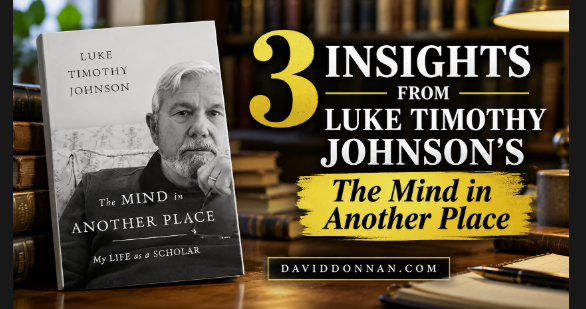
Three Insights from Luke Timothy Johnson’s The Mind in Another Place
October 28, 2026
AI Disclosure: This post was written by myself with AI assistance for grammar, formatting, and clarity. The ideas, reflections, and opinions are my own.
I recently read Luke Timothy Johnson’s The Mind in Another Place: My Life as a Scholar. Last year, I read Thomas Oden’s A Change of Heart: A Personal and Theological Memoir. Oden’s book gave me an appreciation for how little I know about the people whose commentaries and books I read.
Recently, I also discovered Brad East through his writing about the life of a scholar on his blog. This has only deepened my appreciation for and intrigue with scholars.
Here are three insights from The Mind in Another Place: My Life as a Scholar.
1. Luke Timothy Johnson (LTJ) Is a Lay Catholic Scholar
I had heard of LTJ as a famous scholar from several of my colleagues who attended Candler School of Theology at Emory University. Surprise! Not only was he not Methodist, but he also spent years living as a monk before going to Yale for studies and work.
Johnson has a winding and unusual journey which was enlightening and engaging to read about.
2. Jobs of Work and Works of Love
LTJ was a voracious reader and writer. He contributed a large number of articles and books across theology and biblical studies. He also differentiated between jobs of work and works of love.
I thought this was a helpful distinction for any job. There are aspects of any job that might simply be responsibilities we have to fulfill, while other aspects are things we pursue because of our love for the work itself.
3. The Pressure on Scholars
The final takeaway is that scholars seem to feel immense pressure to come up with something new. Part of completing a PhD is contributing to the field of study. LTJ makes it clear: If you want to become a scholar for study alone, that is not enough. He wants scholars to be bold, creative, and think outside the box.
There is a need for this. However, one could see how this could also be less helpful. This is in contrast to Oden, who wanted to contribute nothing new but instead to recapture Classic Christianity.
Should You Read It?
If you are curious about the life of a scholar, I would start with Oden. However, if you want to learn about another important scholar from the past 30 years, you would probably enjoy it. Or, if you want to hear how someone tries to faithfully balance work and care for family, you will gain some insight.
Discover more from David Donnan
Subscribe to get the latest posts sent to your email.
